
Hair
Understanding hair loss.
An age-old problem — but thanks to new discoveries, we are closer than ever to understanding the mechanism of hair loss and treating its causes.
Baldness has been part of getting older for as long as history records. Before minoxidil or hair transplants, men dealt with receding hair however they could: Julius Caesar and Napoleon grew their hair long and combed it forward, George Washington wore a wig, and Eisenhower and Churchill were famously follically challenged.
Pharmaceutical companies know a cure for baldness is worth a fortune, and intensive research continues. We now understand far more about how hair loss happens — and the hope for a cure is alive and well.
How does hair loss happen?
Hair loss usually develops gradually. Contrary to popular belief, baldness is not simply hereditary — if it were, we would be born bald. Certain tendencies and predispositions eventually cause hair loss. With the aid of modern science, Millennium Clinic can identify those tendencies and compensate for them, disrupting the genetic message. Our goal is to restore a normal hair growth cycle and get you back to your confident self.
The hair cycle
Even normal hair growth involves a cycle of shedding. A healthy follicle repeatedly moves through three phases:
Anagen
The growing phase. In a normal scalp about 90% of follicles are growing at any one time, each staying in this phase for two to six years.
Catagen
A brief transitional period beginning around the fifth year, lasting two to three weeks. Less than 1% of your hair is in this phase at any one time.
Telogen
The resting phase. About 10% of hair rests for two to three months, and at the end of it the hair is shed. In a healthy cycle a new hair from the same follicle replaces it.
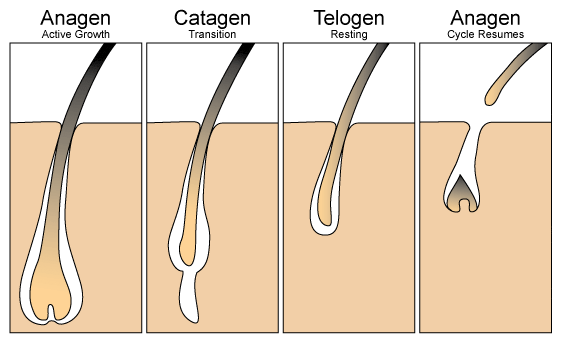
A healthy scalp carries roughly 100,000 to 120,000 hairs and sheds 60 to 80 a day. Hair starts to recede when fewer new hairs re-enter the growth phase. As we age the cycle can become disrupted, more hair sheds, and in time regrowth may stop completely.
Common types of hair loss (alopecia)
The medical term for male or female pattern baldness is androgenic alopecia. It accounts for over 95% of all hair loss: more than 66% of men and over 20% of women experience it during their lifetime. It is characterised by a receding hairline and/or loss on top of the head, with thick pigmented hairs gradually giving way to short, wispy vellus hairs.
Main causes
- Genetic predisposition
- The hormonal effect of androgens
- Reduced blood circulation around the hair follicle
- Deactivation of hair matrix cells
These break down into three main factors: hormonal (testosterone combining with the enzyme 5-alpha reductase to produce DHT, which shrinks sensitive follicles), genetic (inherited from either side of the family), and age (which, with genetics, acts as a time clock triggering enzyme production). Thyroid dysfunction, steroids, medications, disease, trauma, severe stress, chemotherapy and surgery can also trigger hair loss.
Male pattern baldness
A receding hairline and thinning crown, eventually leaving a large bald area on top of the scalp. About 25% of men begin thinning by age 30, and two-thirds are bald or balding by 60.
Female pattern baldness
Thinning throughout the scalp while the front hairline generally remains intact. Genetics, age and testosterone — which tends to rise after menopause — all contribute. One in five women experience hair loss.
Traction alopecia
Gradual loss caused by pulling force on the hair: tight ponytails, pigtails, braids, extensions and weaves.
Alopecia areata
Patchy loss that can progress to complete scalp hair loss (alopecia totalis) or loss of all body hair (alopecia universalis). The immune system attacks the follicles and disrupts normal hair formation. It occurs most often in children and young adults; in about half of cases hair regrows within a year without treatment, but the longer the loss persists, the lower the chance of regrowth.
Thyroid-related hair loss
The conversion of testosterone to DHT appears more pronounced in some patients with hypothyroidism or hyperthyroidism. Rapid loss — thinning hair on the pillow or in the shower — is often accompanied by changes in texture, leaving hair dry and coarse.
Dermatitis and scalp conditions
Dermatitis — inflammation of the skin — is a very common scalp disorder that damages hair, appearing as an itchy red rash: acute (blisters), subacute (scaling and crusting) or chronic (thickened skin from scratching). Folliculitis, a bacterial infection of the follicles, is among the most common skin infections.
Medication side effects
Hair loss is a listed side effect of many common medications, including many arthritis treatments. Always review the medications you take if you notice signs of hair loss.
Where to from here?
See our Hair Repair and Restoration Programs — all drug free, and consequently side effect free.